Cable Protective Coating for Cable Trays and Electrical Systems

Fire protective coating for cable trays and bundles — stops flame spreading along the run and keeps essential circuits live, applied by our certified crews to UAE Civil Defense standard.
Approved

Approved by UAE Civil Defense and trusted by contractors

Mechanism

What it is and how it works

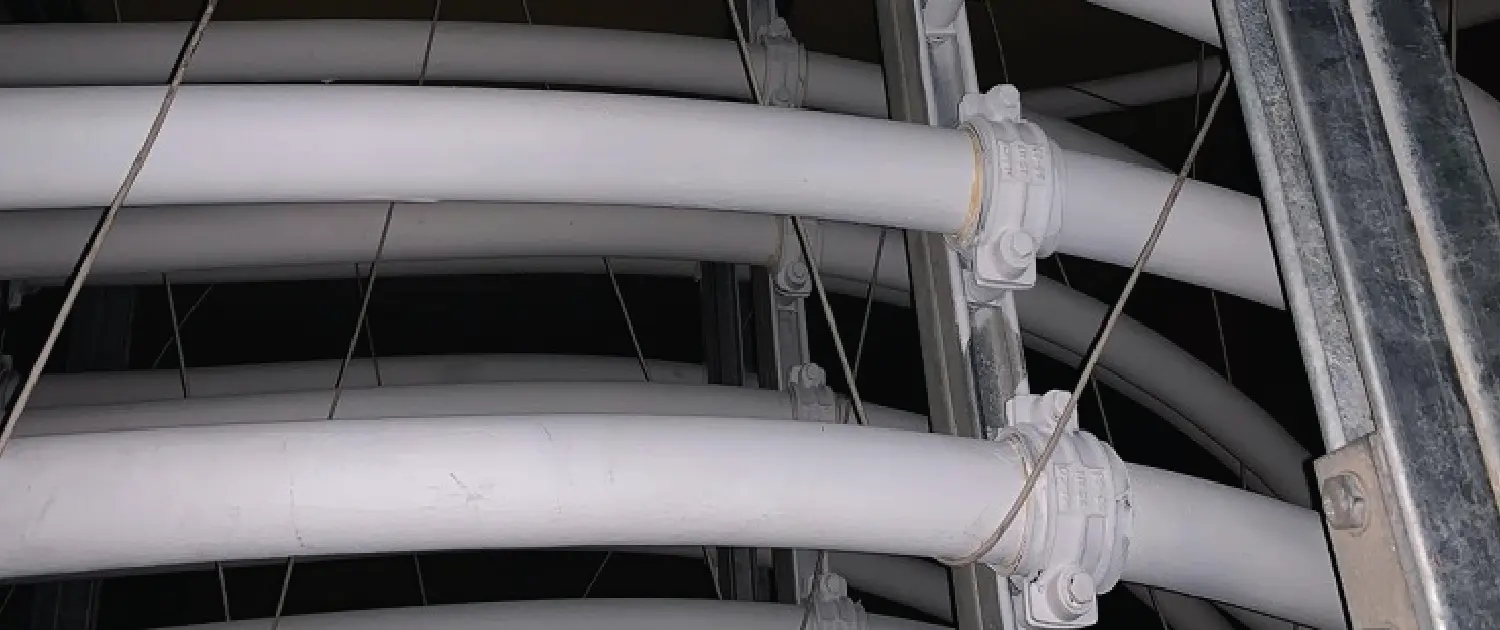
Cable protective coating is a fire-resistive layer applied over installed cables and trays. It does two separate jobs: it stops a fire travelling along the cable run as if it were a fuse, and on tested systems it keeps essential circuits energised long enough for alarms, pumps and smoke control to do their work.

  • Up to 120 minCircuit integrity on tested systems
  • 2 tests, not 1Flame spread and circuit integrity
  • Derating appliesCoated cable sheds heat more slowly

What it is

  • A coating over cable already installed Applied to the outside of cables, bundles and trays that are already in place. It is a property of the protection, not of the cable — which is what makes it a retrofit option on a live building.
  • Intumescent or ablative Intumescent types swell into an insulating char. Ablative types carry chemically bound water that absorbs heat as it is driven off. Both end up doing the same job by different routes.
  • Two jobs, certified separately Stopping flame travelling along the run is one test. Keeping the circuit energised while it burns is another. A system may hold one certificate, both, or neither — always check which.
  • Thickness is the specification The coating performs only at the film thickness it was tested at. Applied by brush or spray, but measured and recorded either way.

How it protects

  1. Heat reaches the run The coating reacts before the cable sheath itself ignites.
  2. An insulating layer forms Intumescent types char and expand; ablative types release bound water and absorb heat as it turns to vapour.
  3. Flame propagation stops Without it, a loaded tray carries fire from one compartment to the next along its own sheathing. The coating breaks that path.
  4. The conductor stays below failure On systems tested for circuit integrity, the cable keeps carrying current for the rated period — up to 120 minutes.
  5. Essential systems keep running Alarms, fire pumps, smoke control and emergency lighting stay energised for as long as the evacuation needs them.

Specification

Fire ratings and coating thickness

Circuit integrity Typically specified for Relative coating build
30minutes Secondary circuits and general runs crossing a fire compartment Lowest
60minutes Fire alarm, emergency lighting and evacuation systems Moderate
120minutes Fire pumps, smoke control and firefighting lifts High
180minutes Tunnels, substations and critical process control, where specified Maximum

Circuit integrity is tested to UL 2196 or ASTM E1725, flame spread to IEEE 1202 or IEC 60332-3 — and flame spread is a pass, not a duration. Build shown is relative, and a coated cable must be derated for ampacity. Send us your cable schedule and we will return the system, the thickness and the certificate.

Range

Systems we apply

On site

How we apply it

  1. Step 01

    Survey and derating

    • Cable types, sizes and grouping recorded against the duration required
    • Ampacity derating agreed with the electrical designer before any coating goes on
    • Damaged or degraded sheathing flagged for repair first
  2. Step 02

    Preparation

    • Cables clean and dry, free of dust, oil and loose debris
    • Runs dressed so every surface can be reached, including undersides
    • Terminations, glands and adjacent equipment masked
  3. Step 03

    Application

    • Brush or airless spray to the specified wet film thickness
    • Successive coats where the system requires them, overcoat intervals observed
    • Full coverage around the bundle, not just the visible face
  4. Step 04

    Verification and records

    • Wet film checked during application, dry film after
    • Thickness recorded run by run against the certified system
    • Package issued for Civil Defence submission

Each stage carries a hold point — work does not proceed until the previous stage is signed off. Derating is settled first for a reason: a coated run that was never derated is a problem discovered under load months later, not at inspection.

Applications

Where cable protective coating is used

Anywhere a cable run crosses a fire compartment, or feeds something that has to keep working while the building is being evacuated.

Cable systems

  • Trays and ladder racks Horizontal runs carrying bundled power and control cable — the most common route a fire takes from one compartment to the next.
  • Vertical risers Shafts where fire climbs fastest, and where a single run can connect every floor in the building.
  • Grouped and bundled runs Bundling raises the fire load and slows heat dissipation — both reasons the specification tightens where cables are densely grouped.
  • Compartment crossings Tray either side of a penetration, working alongside the firestop seal rather than replacing it.

Facilities and environments

  • Data centres Dense cable in tight voids, where continuity of supply matters as much as containment.
  • Substations and switchrooms High fire load in a small space, feeding the supply the rest of the site depends on.
  • Tunnels, metro and car parks Long runs and difficult evacuation, where flame travelling along a tray has nowhere to stop.
  • Process plant and refineries Cable routed through hazardous areas, often alongside hydrocarbon fire risk.

Portfolio

Recent fireproofing work

A record of steel protected, inspections passed, and deadlines met across the Emirates.

Why us

Why contractors specify Ibtikar

  • Certified applicators

    Manufacturer-trained crews using our own spray equipment. The people on your site are ours, not subcontracted labour.

  • UAE and GCC

    Offices in Dubai, Abu Dhabi, Sharjah, Ras Al Khaimah and Umm Al Quwain — plus a Saudi operation, so we mobilise across the region without travel loading the price.

  • Approvals already in place

    Dubai, Abu Dhabi and Sharjah Civil Defence, plus ADNOC, CMW, PGC and Tawazun. See our approvals

  • Documented handover

    Dry film thickness recorded member by member, issued with material certificates and test reports, ready for authority submission.

FAQs

Answers on curing time, retrofits, documentation, and Civil Defense approval scope.

  • Yes, but it requires a protective topcoat to withstand weathering.
  • Water-based intumescent paints are low in VOCs and environmentally friendly.
  • Intumescent paint is a fire-resistant coating that swells when exposed to high temperatures, forming an insulating char layer that protects the underlying material from fire. It is commonly used on structural steel to maintain its integrity during a fire.
  • Intumescent paints are used on structural steel, wood, and other substrates in commercial, industrial, and residential buildings to provide fire protection.
  • Intumescent paints are lightweight, aesthetically pleasing, and provide long-lasting fire protection without adding significant bulk to structures.